Here’s How AI is Reading Your Content
Summary
Structure your content so each section answers one idea clearly and immediately, then add context after. Use simple formatting and direct language so AI can easily extract and reuse your work.
Search used to reward the best page. Now it rewards the best answer.
That sounds small, but it changes how you write everything.
When someone searches, they’re not always clicking through anymore. They’re getting a response pulled together by an AI system that scans multiple sources, extracts pieces, and assembles something useful on the spot.
If your content can’t be easily lifted, understood, and reused, it gets ignored.
Most blogs are still written like someone will sit down and read from top to bottom. That’s not how these systems interact with your content. They scan, isolate, and extract.
If you want visibility now, you need to write in a way that makes your ideas easy to pick up and reuse.
How AI Actually Reads Your Content
AI systems don’t read like people. They break your content into chunks.
Each section becomes its own unit. The system looks at that unit and asks a simple question. Does this answer something clearly?
If the answer is yes, it has value. If the answer is vague or buried in filler, it moves on.
That’s why a lot of well-written content never shows up in AI responses. The ideas are there, but they’re wrapped in too much context.
What matters more now:
Clear statements over clever phrasing
Defined ideas over blended paragraphs
Direct answers over long setups
Think of every section as something that could be copied and pasted on its own. Because that’s exactly what happens.
The “Citation-Ready” Content Model
If you want your content to be used, you need to make each section stand on its own.
Start with one idea per section. Not three. Not a general theme. One idea.
Then answer it directly. Don’t slow-roll it. Get to the point early.
For example:
Weak structure: You spend two paragraphs circling a topic, then land on the insight at the end.
Stronger structure: You lead with the insight, then support it with context.
That shift alone makes a difference. AI systems are more likely to pull the second version because it delivers value immediately.
A simple rule to follow: If someone only read your header and the first two sentences, would they understand the point?
If not, tighten it.
Formatting That Wins AI Pull-Through
Structure isn’t just about what you say. It’s how you present it.
Headers should be clear and specific. Skip vague phrases that rely on curiosity. A good header tells you exactly what the section delivers.
Instead of: “Why This Matters”
Go with: “How AI Decides Which Content to Use”
Bullet points help more than long paragraphs when you’re breaking down steps or ideas. They create a clean separation, which makes extraction easier.
Short paragraphs work better than dense blocks. You want visual clarity.
Definitions and summaries also perform well. If you can explain something cleanly in two or three sentences, do it. Those sections get reused the most.
Years ago, I attempted writing a blog about “what is a headless CMS” for Contentful built on this principle, and it was the shortest piece for the keyword.
Now, it still ranks #1 and is cited by Google’s AI overview.
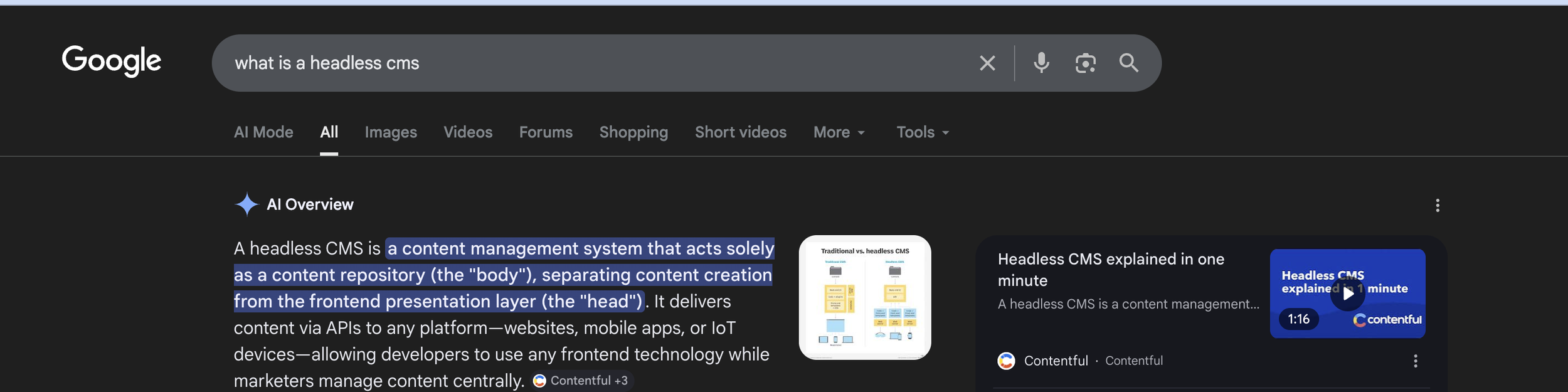
Google AI overview
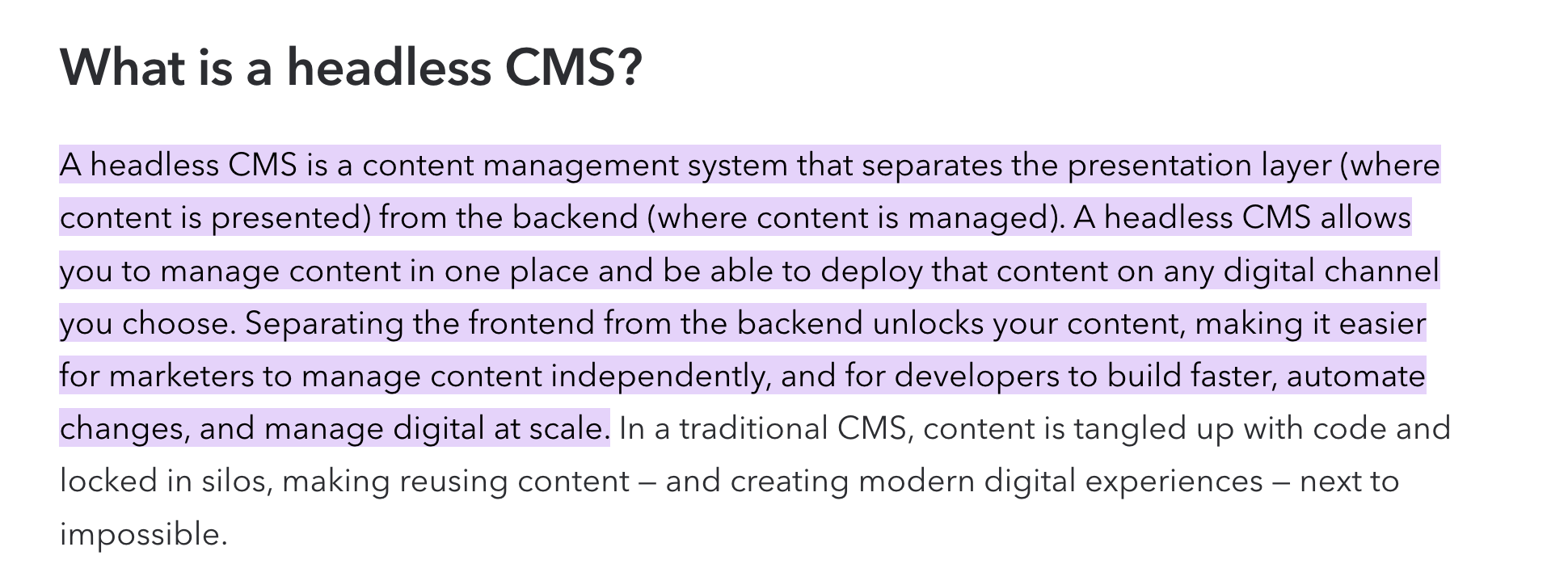
Contentful definition
I’ll say it until I’m blue in the face. Get to the point and answer questions with clarity.
Building Authority Without Saying It
You don’t need to tell people you know what you’re doing. Structure and clarity handle that.
What builds trust now is specificity.
Generic advice blends together. It sounds like everything else online. AI systems pick up on that. So do readers.
Instead of saying: “Focus on writing high-quality content”
Say: “Start each section with a direct answer, then expand. Most writers do the opposite, which makes their content harder to extract.”
One is broad. The other shows understanding.
Depth matters more than length. You can write 2,000 words and still say very little. Or you can write 800 words that are tight and useful.
The second version is more likely to be used.
If your content reflects real experience and clear thinking, it shows. You don’t need to layer on claims.
A Simple Workflow You Can Steal
If you want to apply this without overthinking it, use a simple process.
Start with your outline: List the key questions or ideas you want to cover.
Then isolate each one: Turn every point into a standalone section.
Write the answer first: Open each section with the clearest version of your point.
Expand after: Add context, examples, or nuance once the main idea is clear.
Edit for extraction: Go back and look at each section on its own. Ask if it makes sense without the rest of the article.
If it does, you’re on the right track.
If it depends on previous sections, tighten it.
What This Means for Writers Moving Forward
This shift isn’t a trend. It’s a change in how content gets discovered and used.
Search visibility is becoming less about where you rank and more about whether your content is useful enough to be pulled into answers.
Writers who adapt to this will stand out quickly. Most people are still writing the old way.
If you focus on clarity, structure, and direct answers, your content becomes easier to use. That increases your chances of showing up where attention is moving.
The opportunity is still there. The rules just look different now.
