AI is Giving Quick Answers to People. Your Blog Should, Too
Search behavior has changed faster than most content strategies have. AI now answers questions directly. In many cases, the user never visits a website at all.
This creates a simple requirement: your content has to deliver the answer immediately, or it gets skipped.
I’ll walk through what that means, show how it’s already working in practice, and outline how to adjust your blog structure so it stays relevant in a zero-click environment.
The Shift: From Ranking for Clicks to Supplying Answers
AI-powered search surfaces pull from content that resolves intent quickly. They are not looking for buildup or narrative. They are looking for clarity.
Traditional blog structure slows this down. A typical post might look like:
100–150 words of introductory context
A transition into the topic
A header that finally answers the question
That delay used to be acceptable. Ranking meant earning the click, and the click justified the pacing.
Now, the answer itself is the product. If your content does not surface it immediately, it’s less likely to be included in AI-generated responses.
This changes how content should be structured at a fundamental level.
What I Did Differently (And Why It Worked)
I applied this directly in a post written for Cloudflare, targeting the keyword: “what is a DDoS attack.”
Instead of following the standard format, I removed the introduction entirely.

The post opens with a direct definition in under 100 words. No setup. No framing. Just a clear explanation of what a DDoS attack is.
After that, the rest of the article expands on the topic in a structured way. But the core intent is resolved immediately.
The result: the page ranks #1 for the keyword.
This is all about front-loading value. The reader, and more importantly, the AI layer, gets what it needs right away.
This Is Already Reflected in AI Citations
This pattern is not limited to one example.
For the same keyword, AI-generated responses frequently cite content from Microsoft and Fortinet.
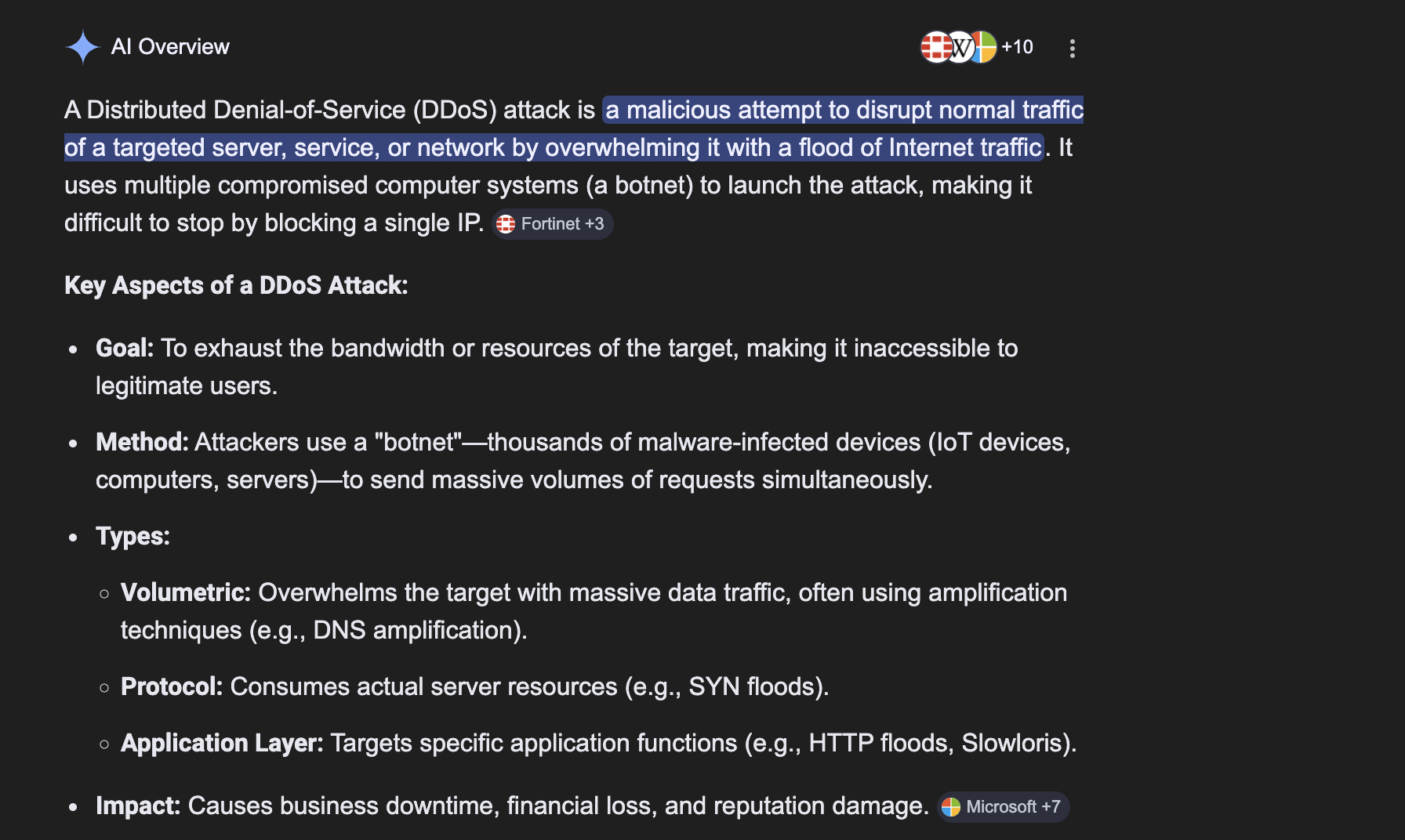

Microsoft’s Article

Fortinet’s Article
Both follow the same structural approach:
A direct definition appears at the top
The answer is clear within the first few lines
Supporting content comes after, not before
These are not stylistic choices. They are structural decisions that align with how AI systems evaluate usefulness.
Content that resolves intent quickly is easier to extract, summarize, and trust.
What This Means for Your Blog Strategy
Blog content is no longer evaluated only by how well it engages a human reader over several paragraphs.
It’s now evaluated by how efficiently it answers a question.
That changes the role of your introduction, your headers, and your overall flow. The goal is no longer to guide someone toward the answer. The goal is to present the answer immediately, then build around it.
This is especially important for product-led content. When your blog is tied to a product or category, clarity at the top of the page directly influences how your brand shows up in AI responses.
If your structure delays understanding, your content becomes harder to use as a source.
How to Adapt: Practical Changes You Can Make
Start by rethinking how your content opens.
Lead with the answer. The first 1–2 paragraphs should directly resolve the primary query.
Remove filler introductions. Context can come after the definition, not before.
Use headers to expand, not to introduce the core idea. The main question should already be answered before the first header.
Then, refine how the rest of the content supports that answer.
Break explanations into clear, scannable sections
Add depth after clarity, not instead of it
Keep language direct and specific
Finally, consider how your content will be extracted.
Write definitions that stand on their own
Avoid unnecessary qualifiers or vague phrasing
Make each section independently useful
The standard blog format was built for a different version of search. That version assumed attention and rewarded pacing.
The current environment rewards immediacy.
If AI is giving quick answers, your blog should be structured to do the same.
